For years, cancer patients have reported seeing flashes of light during radiation therapy. After careful observation, scientists have caught this light on camera, and discovered what causes it. Cherenkov radiation is a type of light caused by charged particles (such as electrons) travelling through a material at high speed. This effect is the reason that … Continue reading Eyes light up with radiation therapy
Author: Lachlan
Upcycling goes down in history
The word ‘upcycling’ was invented in the 1990s to describe reusing old items in new ways, instead of throwing them out. However, it turns out upcycling has been done for a lot longer than this – three thousand years longer. Archaeologists have spent the last seventeen years excavating an ancient manufacturing site called Saruq al-Hadid … Continue reading Upcycling goes down in history
Ginkgo trees: Forever young
All living things have a life cycle: they’re born, they age and eventually they die. At least, most living things follow this pattern. Ginkgo trees don’t suffer from old age, which means they may be able to live forever. Chinese researchers studied a group of trees ranging between three and 667 years old. They found … Continue reading Ginkgo trees: Forever young
The curious case of the three-tailed lizard
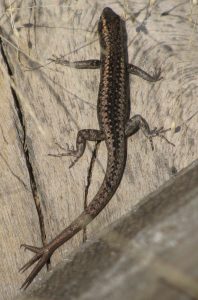
Imagine being able to regrow lost body parts. This sounds useful until it goes wrong: what happens if you grow an extra part you don’t need? This is what happened to a lizard I found last year - it had three tails. The lizard was a Ragged Snake-eyed Skink (Cryptoblepharus pannosus) that lived near my … Continue reading The curious case of the three-tailed lizard
How to get away with space piracy
You're probably wondering what a headline like that is doing on a science blog like this. Space piracy is firmly the stuff of science fiction - or is it? The final frontier is opening up for business, and bringing with it a whole new set of morally questionable opportunities. Asteroid mining, while sounding just as … Continue reading How to get away with space piracy
Squawkzilla: King of the parrots
When scientists unearthed large fossilised leg bones in New Zealand, they assumed they belonged to an ancient eagle. Ten years later, they realised they were wrong – these were the fossils of the largest parrot to ever walk the Earth. Heracles inexpectatus (Hair-a-cleeze in-ex-pec-tay-tus) stood about a metre tall – as tall as a four-year-old … Continue reading Squawkzilla: King of the parrots
Slugs put predators in sticky situation
If slugs are so slow, how do they escape predators? Easy – slow them down even more. Scientists from Newcastle were doing research in the nearby Watagan Mountains when they found a tree frog stuck to a branch. Right next to where it was trapped was a red triangle slug. The scientists watched it for … Continue reading Slugs put predators in sticky situation
Wasps learn their A, Bee, C’s
If A is larger than B, and B is larger than C, which is larger out of A and C? This question tests a kind of logic called transitive inference. It allows you to figure out information you haven’t been told, based on relationships you do know. Only some animals, including humans, monkeys and fish, … Continue reading Wasps learn their A, Bee, C’s
Meet the world’s newest old trees
A group of bald cypress (SIGH-press) trees in the United States have just been discovered to be among the oldest in the world. One of them is at least 2624 years old, making it the fifth-oldest living tree on the planet. Researchers measured this by taking a small core sample of the tree’s trunk, from … Continue reading Meet the world’s newest old trees
Rare bear in the DMZ
For over sixty years, no-one has been allowed into the Korean Demilitarised Zone (DMZ), the border between North and South Korea. The Korean War left the 2.5 kilometre-wide area filled with landmines, but since then, nature has taken over. Thousands of species are estimated to live there, and we’ve just discovered that this includes bears. … Continue reading Rare bear in the DMZ
 Lachlan Writes Science