Humans love to fool each other with optical illusions, but we aren’t the only species that falls for these tricks. Several famous illusions can be found in nature, each helping animals and plants to survive and reproduce.
The Ebbinghaus Illusion
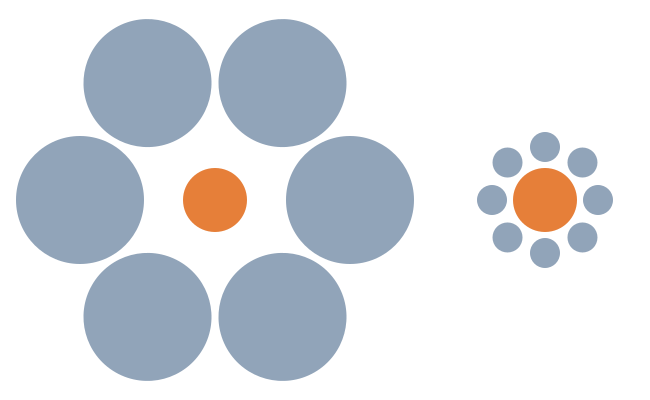
Which orange circle is bigger? While they don’t look like it, they’re actually both the exact same size.
This illusion was invented by the German psychologist Hermann Ebbinghaus. He showed that if you surround an object with smaller shapes, it seems bigger than it actually is. When you use big shapes around the outside, the middle one looks small.
Many scientists have studied this illusion to try and figure out how it works. They’ve shown it to dolphins, bowerbirds, chickens, fish, pigeons, dogs, baboons and bees; most of these animals are also fooled.
Some flowers use this illusion to attract insects such as bees to their pollen. The Wurmbea plant has white flowers with dark centres and a thick line halfway along each petal. By making the flower itself look small, the plant fools insects into thinking the centre is larger, with lots of delicious pollen to collect.
Forced Perspective
Forced perspective is a type of illusion that uses distance to make things look larger or smaller than they actually are. If you’ve ever taken a photo where you pretend to look big compared to something far away, you’ve used forced perspective.
Bowerbirds are known for creating complicated structures called bowers that males use to attract and impress mates. This generally involves building a viewing area out of sticks, then covering the ground with objects of a particular colour.
Male great bowerbirds decorate their bowers with white and green items like leaves, rocks and bones. They arrange these with the smallest at the front, and bigger items further away. This creates a forced perspective illusion; when a female stands in the viewing area, all the objects seem to be the same small size.
The male then parades for her at the end of the bower, showing off some brightly-coloured items. Because the female thinks everything on the ground is small, the Ebbinghaus illusion makes him and his treasures look bigger and more impressive than they actually are.
Wagon Wheels and Barbers’ Poles
If you were designing a well-camouflaged animal, black-and-white stripes in a brown grassland probably wouldn’t be your first thought. However, some scientists suggest that zebras’ patterns do protect them from being eaten, through the help of two optical illusions.
The first illusion is called the wagon-wheel effect. It’s what makes car wheels and plane propellors seem to be spinning at a different speed or in the opposite direction to their actual movement.
The second is the barber’s pole illusion. This is created when you turn a cylinder with a spiral drawn around its side; you can try this yourself using a toilet roll. It looks like the line is moving up or down the cylinder, depending on which way you turn it.
Some scientists think that zebras’ stripes create similar illusions when they move, and this confuses predators. Other studies have shown that biting insects find it difficult to land on striped surfaces, possibly for the same reason.
This article was published in Issue 40 of Double Helix magazine (https://www.csiro.au/en/Education/Double-Helix). Copyright for this article is held by CSIRO.

 Lachlan Writes Science